The Death of the Follower
Social media isn’t dying. The rules of attention are changing.
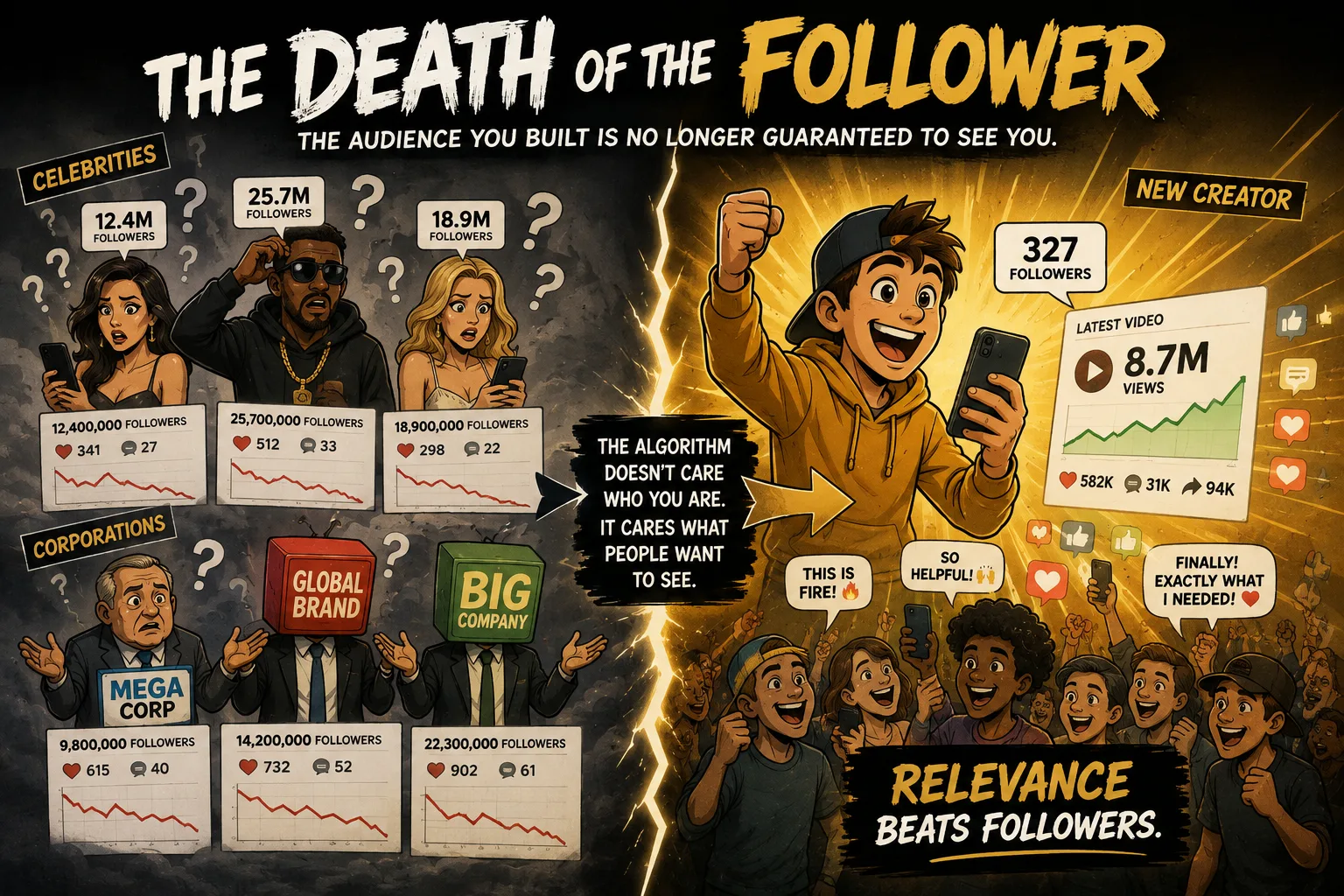
For nearly two decades, businesses have been given the same advice:
Build your following.
Get more Facebook followers. Grow your Instagram audience. Build your LinkedIn network. Get subscribers. Get likes.
The logic was simple.
If 10,000 people followed your business, you had an audience of 10,000 people. When you had something to say, you posted it, and at least some meaningful percentage of those people would see it.
Businesses spent years — and often enormous amounts of money — building those audiences.
But something fundamental has changed.
You may have already felt it.
You post something to a page with thousands of followers and wonder where everyone went.
The likes aren’t there.
The comments aren’t there.
The reach isn’t there.
And business owners understandably begin asking:
What am I doing wrong?
Perhaps nothing.
Because the audience you spent years building may no longer be the audience seeing your content.
Welcome to the death of the follower.
From Social Media to Interest Media
Gary Vaynerchuk recently described this shift with a phrase I think captures it perfectly:
Social media is becoming interest media.
Think about what the original social-media feed was designed to do.
You followed people.
Then the platform showed you content from those people.
It was essentially a digital newspaper assembled from your chosen relationships.
Today, open TikTok, Instagram, Facebook, YouTube or increasingly even LinkedIn, and something very different happens.
Algorithms study what you watch.
What you skip.
What you search for.
What you share.
What makes you stop scrolling.
What holds your attention.
Then artificial intelligence attempts to determine what you are interested in — and feeds you more of it.
That means the most important question is no longer:
“How many people follow you?”
It is becoming:
“How relevant is this piece of content to this particular person?”
That is an enormous change.
15 Million Followers vs. Zero
Vaynerchuk recently illustrated this with an extraordinary experiment.
He posted essentially the same video on two TikTok accounts.
One account had approximately 15 million followers.
The other had zero.
The account with 15 million followers received roughly 300,000 views.
The account with zero followers?
9.4 million views.
Read that again.
Zero followers.
Millions of views.
For a business owner who spent the last decade being told to accumulate followers, that should get your attention.
The algorithm wasn’t asking which account had earned the largest audience historically.
It was asking whether this piece of content was interesting enough to earn an audience today.
That changes the game.
You Don’t Own Your Audience
There is an uncomfortable lesson here.
You never really owned your social-media audience.
The platform did.
You were simply given access to it.
For years, that access was generous enough that we began confusing followers with ownership.
A business with 25,000 followers felt as though it possessed a database of 25,000 potential customers.
It didn’t.
It had 25,000 people who had previously told a technology company:
“I might be interested in hearing from this business again.”
The technology company still controlled whether that introduction happened.
And now those companies have discovered something considerably more powerful than the follower graph:
the interest graph.
Instead of asking whom you know, algorithms can increasingly predict what you want.
That is why a teenager with 37 followers can publish something tomorrow morning that reaches three million people.
And a corporation with 300,000 followers can publish something that disappears without a ripple.
Followers haven’t become worthless.
But they are losing their monopoly on distribution.
Welcome to the Age of Relevance
This sounds terrifying if your marketing strategy has been built around audience size.
I actually believe it represents one of the greatest opportunities small businesses have had in years.
For decades, marketing favored scale.
The company with the biggest advertising budget could buy the most attention.
The celebrity with the largest following could command the most reach.
The corporation with the biggest media presence could dominate the conversation.
Artificial intelligence is beginning to disrupt that hierarchy.
Because machines don’t care how impressive your building is.
They don’t care how many employees you have.
They don’t care that your competitor has been in business 30 years longer than you.
And increasingly, they don’t care that your competitor has 100 times more followers.
They care about relevance.
Can they understand what you do?
Can they understand whom you help?
Does your content answer the question someone is asking?
Does it hold attention?
Does it demonstrate expertise?
Does it generate engagement?
Does the rest of your digital presence reinforce the same message?
If the answer is yes, a small business can suddenly find itself standing beside — or even ahead of — a much larger competitor.
That is remarkable.
The Same Revolution Is Happening Everywhere
This isn’t merely a social-media story.
That’s the part I believe business leaders need to understand.
Look at what is happening across the internet.
Social platforms are deciding what content to show based upon relevance.
Google is increasingly using AI to determine which information best answers a search.
Consumers are asking ChatGPT and other AI systems questions they once typed into search engines.
Recommendation engines determine which videos, products, restaurants, businesses and ideas appear in front of us.
Different platforms.
Same fundamental shift.
The internet is moving from:
“Show me the people and companies I already know.”
toward:
“Show me the best answer for what I need right now.”
That is the Age of Relevance.
And it will fundamentally change how businesses compete.
Built for Machines. Chosen by People.
There is an important distinction here.
Optimizing for AI does not mean creating content for robots.
Quite the opposite.
The machines are increasingly attempting to predict what human beings will find useful.
That means the winning strategy isn’t gaming an algorithm.
It’s becoming genuinely useful.
Answer real questions.
Teach something.
Solve problems.
Tell stories.
Demonstrate expertise.
Create things people actually want to watch, read and share.
Then make sure your digital infrastructure clearly communicates who you are, what you do and whom you serve so machines can understand it too.
The businesses that thrive will learn to do both.
Create for people. Structure for machines.
Your Next Customer May Never Follow You
This may be the most important mindset shift of all.
Your next great customer may never follow your business.
They may never like your Facebook page.
They may never subscribe to your YouTube channel.
They may never know your company exists until the precise moment they need what you provide.
And at that moment, somewhere behind a screen, an algorithm may make an introduction.
“You should see this.”
“You should watch this.”
“This company may be able to help you.”
That introduction is becoming one of the most valuable pieces of real estate in business.
And you cannot purchase it simply by accumulating followers.
You have to earn it through relevance.
So perhaps social media isn’t dying at all.
Perhaps something else is.
The era in which businesses could accumulate an audience and assume they would always have access to it is ending.
The follower isn’t completely dead.
But the throne is empty.
And relevance is taking the crown.
THE LEADERSHIP REVIEW
The next era of marketing won’t necessarily belong to the businesses with the biggest audiences.
It will belong to the businesses that people trust, machines understand, and algorithms consider relevant enough to introduce.