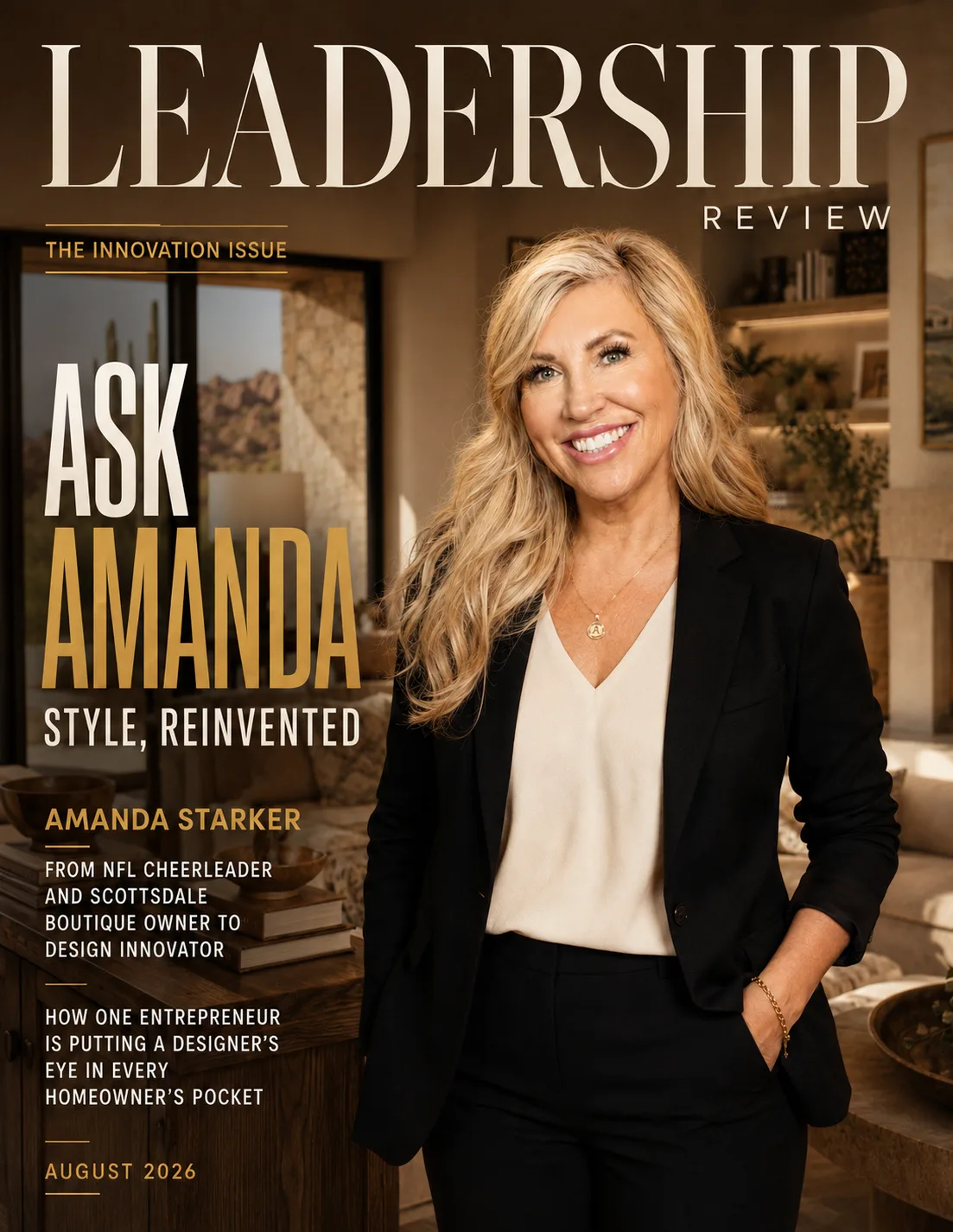
Ask Amanda: Style, Reinvented
How Amanda Starker is turning a lifetime of fashion, design, and organization into a new way for people to see what their homes can become.
Most people do not need another photograph of a perfect room.
They have seen plenty of those.
They have scrolled past the immaculate kitchens, the untouched living rooms, and the beautifully styled spaces that appear to have been designed for people who own neither children nor charging cables. They know what perfection looks like. What they often cannot see is the possibility hiding inside the room they already have.
That is the idea behind Ask Amanda, an emerging AI-guided experience being developed for Sort & Styled by Amanda Starker.
The premise is simple: What if someone could show Amanda a room, explain what is not working, identify what matters most, and receive a thoughtful vision for what that same space could become?
Not a stranger's room. Not a stock photograph. Not a fantasy that requires throwing away everything they own.
Their room. Their life. Only lighter, calmer, and more intentionally arranged.
That distinction is where the real innovation begins.
A Career That Was Quietly Building Toward This
Ask Amanda may be a new idea, but the eye behind it has been developing for decades.
Amanda's story has moved through several worlds that appear different until you understand what they have in common. She is a former NFL cheerleader. She built a career in high-end retail fashion and owned a couture boutique in Scottsdale. For roughly a decade, she has worked in professional organizing and design, helping people make their homes more functional, beautiful, and livable through Sort & Styled.
Each chapter sharpened a different part of the same instinct.
Cheerleading taught presentation, discipline, and the effect of details working together. Fashion developed her understanding of proportion, color, personality, and the difference between following a trend and possessing style. Retail taught her how to listen for what a client is trying to say before the client has found the words to say it. Organizing and design brought all of those lessons into the most personal place of all: the home.
Amanda did not leave those earlier careers behind. She carried them forward.
That is what reinvention looks like when it is done well. It is not the rejection of everything that came before. It is the moment when the old chapters finally reveal what they were preparing us to do next.
The Question That Changes the Room
Most design tools begin by asking what a person wants to add.
Ask Amanda begins somewhere more human.
What is bothering you about this room?
Then comes an even more revealing question:
What must stay?
That second question may be the most important feature in the entire experience.
Homes are not blank canvases. They are collections of relationships, memories, habits, compromises, and unfinished seasons. The chair may be too large for the corner, but it belonged to someone's father. The table may not be fashionable, but it is where the family gathers. The room may be cluttered because life has been difficult, not because the person living there lacks taste.
Good design recognizes those truths. Good leadership does, too.
It is easy to arrive with a grand vision and sweep away everything that does not fit it. It takes greater wisdom to identify what is worth preserving and build the future around it.
That philosophy sits at the center of Ask Amanda.
From Overwhelm to Possibility
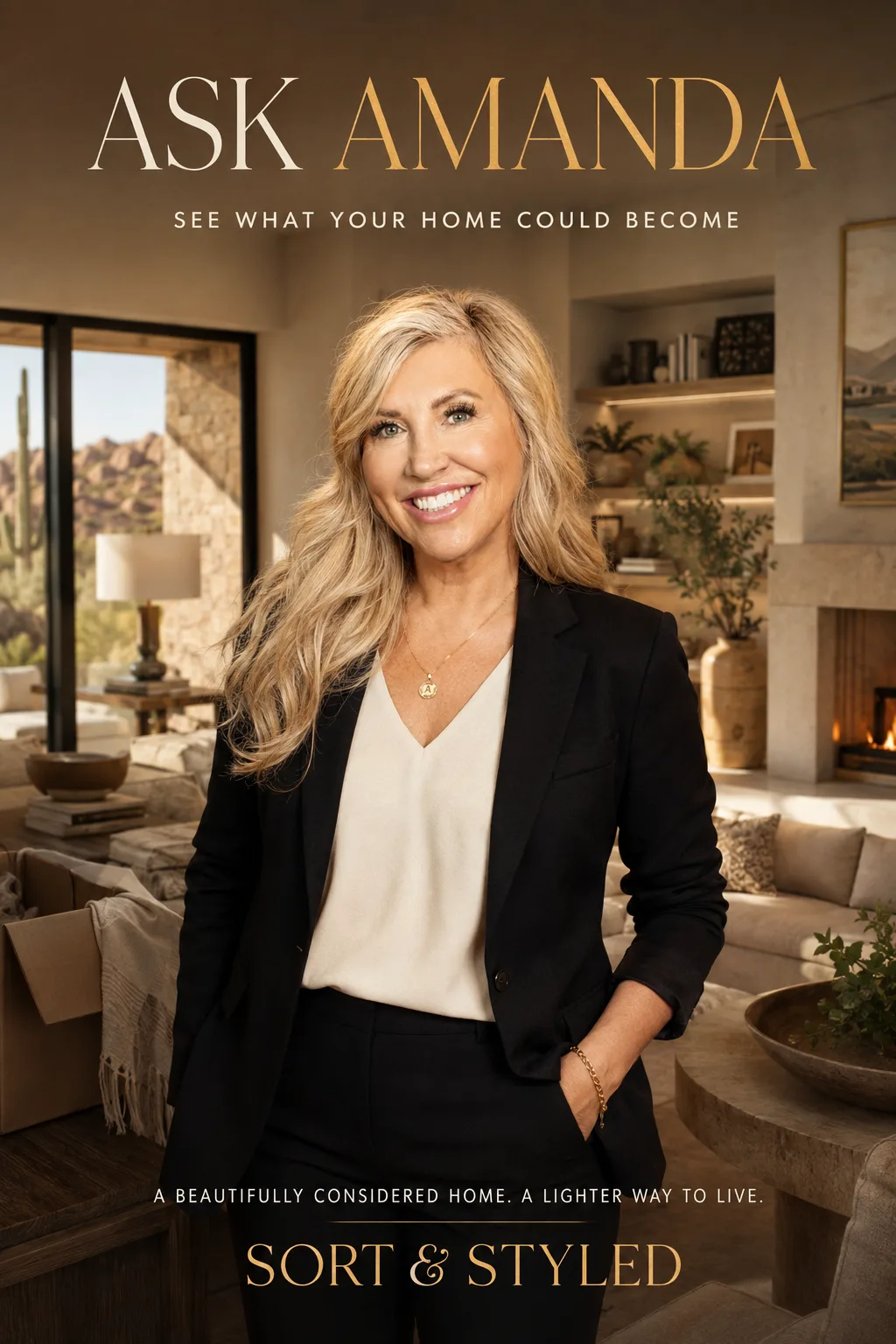
The cover of the Ask Amanda experience being developed for Sort & Styled.
The intended experience is designed to feel less like operating software and more like beginning a conversation with Amanda herself.
A user identifies the room and the problem. They explain what is bothering them, select visual style cues, and identify the pieces that must remain. They then provide an image of their actual space.
From there, the experience is meant to guide them through a restrained, thoughtful sequence:
Reading the room…
Considering what stays…
Composing your vision…
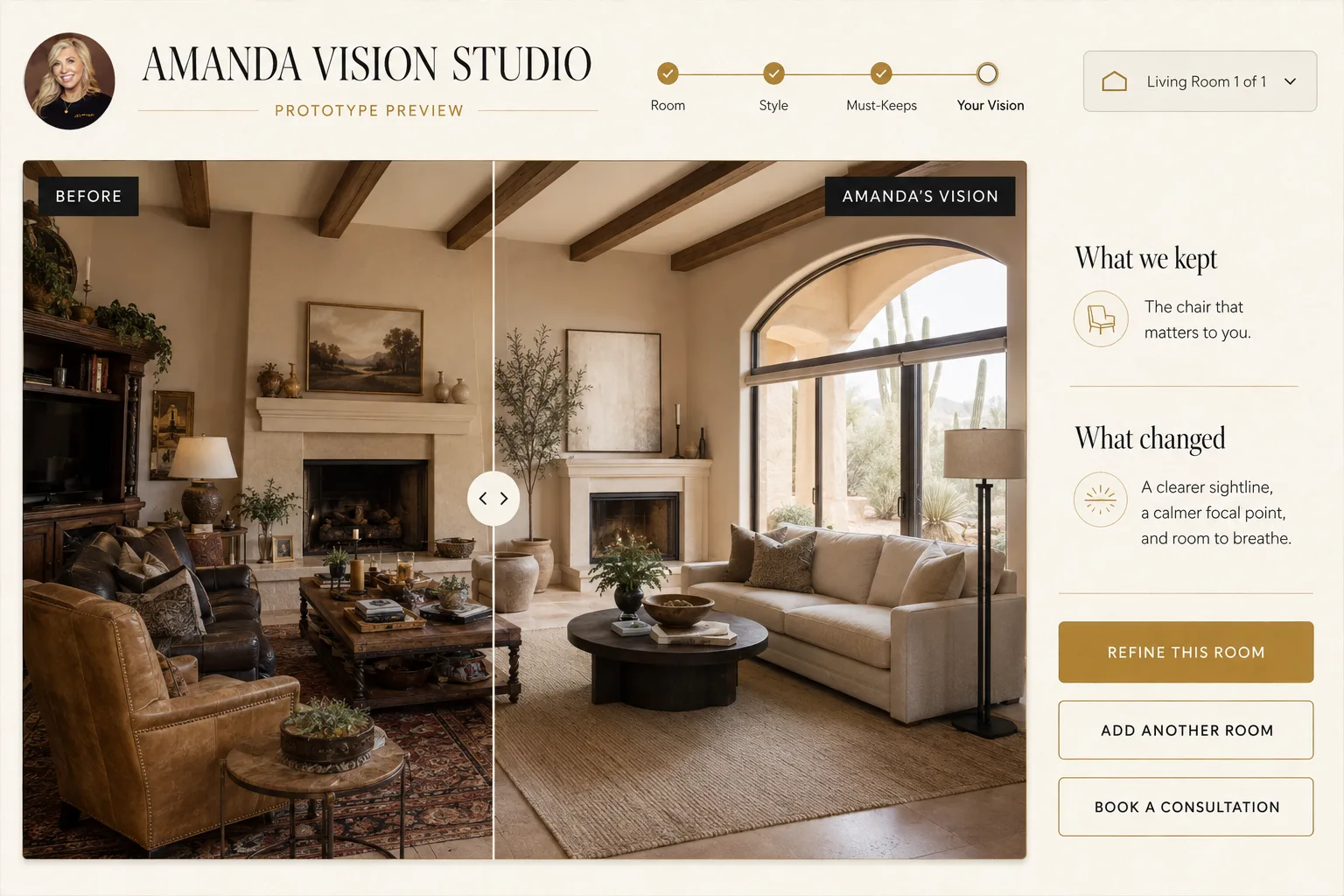
A sample of how the experience works: the same room, reconsidered, with a plain explanation of what was kept and what changed.
The result is not meant to be a random, AI-generated dream room. It is intended to be a visualization of the same room — reconsidered through Amanda's approach — with a before-and-after reveal and a written explanation of why the proposed changes work.
The user can then refine the direction, explore another room, preserve the concept, or schedule a consultation with Sort & Styled when they are ready to turn the vision into reality.
The goal is not merely to produce a beautiful image. It is to help someone move from, "I know this room is not working," to, "Now I can finally see what it could be."
That is a meaningful shift. Overwhelm thrives in ambiguity. Momentum begins when possibility becomes visible.
Technology With a Human Point of View
Ask Amanda is still being developed, and the complete room-rendering experience has not yet been released. That is worth stating plainly because innovation does not need smoke and mirrors. If a product is meant to build trust, the way it is introduced should be trustworthy too.
The current vision is not to create another automated decorating toy or pretend that a machine can replace the judgment of an experienced professional. It is to build a digital doorway into Amanda's expertise.
AI can generate an image. It can identify patterns, interpret visual information, and produce options at extraordinary speed. But it does not know why a certain piece matters. It does not feel the tension between beauty and daily life. It does not understand the relief someone feels when a room finally works again.
Amanda does.
That is why the strongest version of this app will not be the one that makes Amanda unnecessary. It will be the one that makes her way of seeing more accessible.
The future of expertise is not replacing the expert. It is finding thoughtful ways to let more people experience what the expert knows.
That principle extends far beyond interior design.
Too many businesses begin their AI strategy by asking, "What can this technology do?" The better question is, "What do we do so distinctly, so consistently, and so well that it is worth teaching technology how to carry it farther?"
For Amanda, the answer is not simply organizing a room or choosing attractive furnishings. It is her ability to see the person inside the space — to recognize what is causing friction, understand what should remain, and create order without stripping away identity.
Ask Amanda is an attempt to translate that gift into an experience someone can begin from home.
A Better First Step
There is also a quiet business lesson in the way the experience is being conceived.
Traditional service websites often introduce a company, display photographs, list services, and ask visitors to fill out a form. They explain what the business does, but they leave the visitor responsible for imagining the outcome.
Ask Amanda reverses that order.
It gives the person something valuable first: clarity. It helps them articulate the problem, see a direction, and understand what kind of help may be appropriate. A consultation no longer feels like a leap into the unknown. It becomes the natural next step in a journey that has already begun.
This is where the next generation of small-business technology becomes especially compelling. A website no longer has to function as a digital brochure. It can become a meaningful first experience of the business itself.
The customer does not merely read that Amanda understands rooms. The customer begins to feel understood.
The Leadership of Seeing What Could Be
Leadership is often described as the ability to cast a vision. But vision is not limited to boardrooms, stages, or sweeping plans for the future.
Sometimes vision is standing inside a crowded room and seeing calm.
Sometimes it is looking at a career that has moved through performance, fashion, retail, design, and organization — and recognizing that none of those chapters were wasted.
Sometimes it is understanding that technology should not erase the human story behind a business. It should carry that story to places the person could not reach alone.
Amanda Starker has spent years helping people see more possibility in the spaces around them. Ask Amanda represents the next expression of that work: a chance to place her perspective into the hands of someone who may not yet be ready to hire a designer, may not know where to begin, or may simply need to see that change is possible.
That is not technology for technology's sake. It is innovation in service of confidence.
The app will evolve. The visual tools will improve. The experience will become more capable. But its value will depend on whether it remains rooted in the question that made the idea meaningful in the first place:
What is worth keeping — and what could this become?
For the woman whose career has been shaped by helping people answer both, the future feels less like a sudden pivot and more like an arrival.
A beautifully considered home. A lighter way to live.