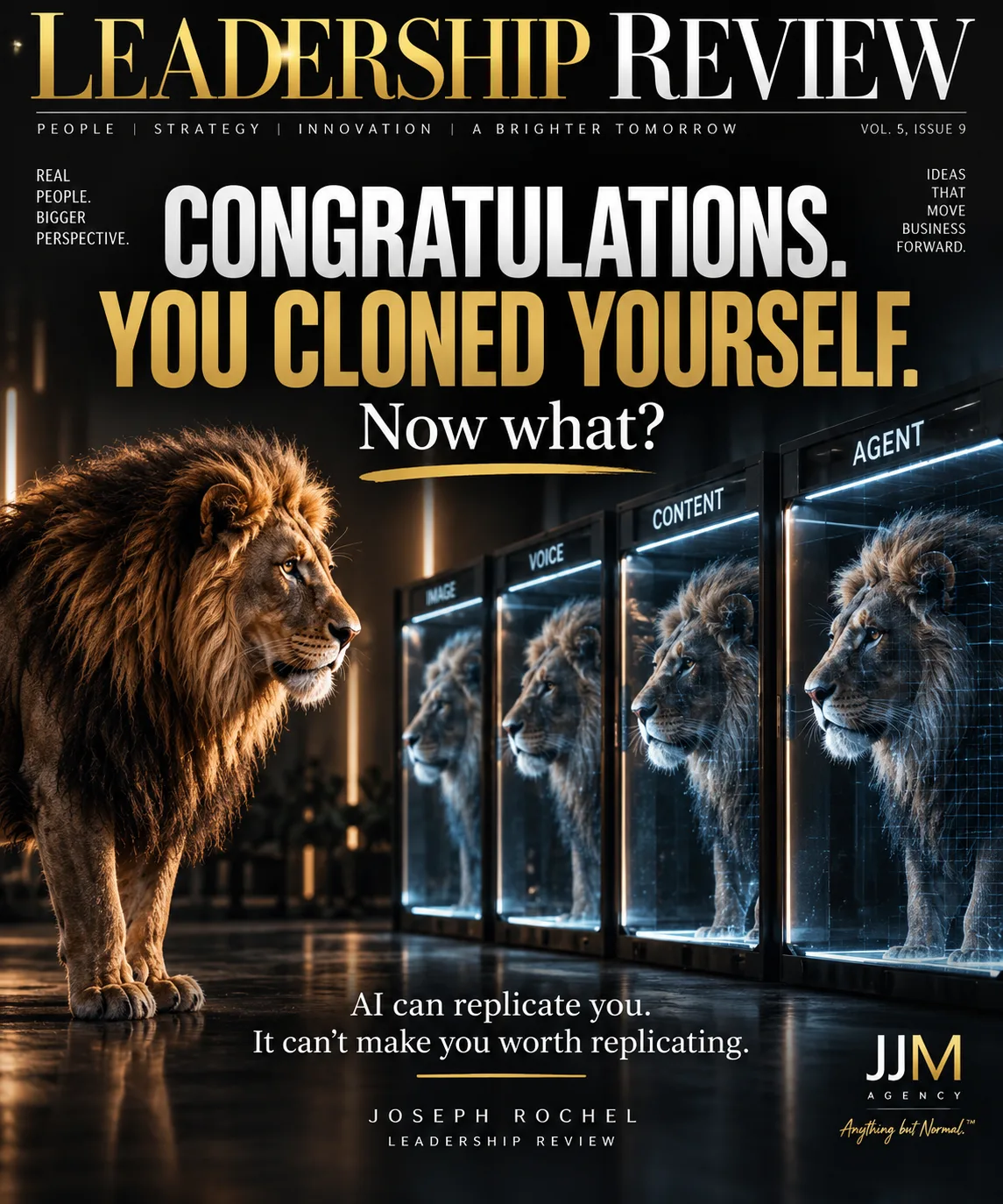
Congratulations. You Cloned Yourself. Now What?
AI can replicate your face, voice, knowledge and content. It still can't give the clone anything worth saying.
There is a new promise making its way through the AI gold rush.
Walk into a workshop at 11 a.m.
Walk out at 4 p.m. with four clones of yourself.
Your brain. Your image. Your voice. Your video.
Five hours.
Apparently, immortality now comes with a lunch break.
And here's the uncomfortable part: they probably can do it.
That's what makes this conversation much more interesting than simply pointing at another ridiculous AI advertisement.
The technology has become astonishingly good. We can create an AI avatar that looks like you. Clone your voice. Feed an AI system your writing, presentations, videos, processes and intellectual property until it begins responding remarkably like you. We can connect agents to workflows and give those agents the ability to perform tasks while you sleep.
None of that is science fiction anymore.
But somewhere along the way, we started confusing replication with value.
And those are two very different things.
The Clone Is Becoming a Commodity
Here's what nobody selling the five-hour AI miracle particularly wants to talk about:
Soon, everyone will be able to do this.
The technology required to clone your voice is becoming easier. Creating realistic avatars is becoming cheaper. Building AI agents is becoming simpler. Connecting sophisticated automations increasingly requires little or no code.
Eventually, saying "I have an AI clone" will be about as impressive as saying "I have a website."
Congratulations. So does your plumber.
The competitive advantage isn't having the technology. It's what you built underneath it.
AI Can Clone Your Knowledge. It Cannot Manufacture Your Wisdom.
This distinction is going to become enormously important.
Knowledge is information you possess. Wisdom is knowing what to do with it.
An AI system can ingest twenty years of someone's emails, books, videos, presentations and conversations.
But those twenty years mattered because a human being lived them.
They made bad decisions. Lost money. Trusted the wrong people. Found the right people. Built things that failed. Built other things that succeeded for reasons they didn't initially understand.
They sat across tables from customers. Watched body language. Had difficult conversations. Made payroll. Lost accounts. Won accounts. Changed directions.
Eventually, they developed something incredibly difficult to upload into a database: judgment.
They learned when the spreadsheet was wrong. They learned when conventional wisdom was wrong. And perhaps most importantly, they learned when they were wrong.
That's the stuff worth cloning.
And you don't get it at a workshop between 11 and 4.
I Know Because I've Built One
For more than six months, my team and I have been building, testing and perfecting James, our AI-powered marketing intelligence system.
And James works.
But he didn't come out of a five-hour workshop.
We built him. Then we broke him. Then we fixed him. Then we broke something else.
We put him in front of real businesses and real-world problems. We discovered situations we hadn't anticipated. We rewrote instructions. Changed workflows. Added safeguards. Removed things we once thought were brilliant. Rebuilt systems we thought were finished.
Then we tested them again. And again.
Today, James is built.
He isn't a concept. He isn't a prototype. He isn't something I'm hoping will eventually work.
He's working.
But six months of building James taught me something important: finished doesn't mean you stop improving.
Every client teaches us something. Every new use case exposes another opportunity. Every failure makes the system stronger. And every technological advancement gives us another tool to make James better.
That's what building real technology looks like.
We could have packaged an early version months ago, created a beautiful landing page and started selling the dream.
We didn't.
Because there is an enormous difference between an AI system that performs beautifully during a demonstration and one you're willing to put your reputation behind.
James doesn't need to impress someone for 20 minutes. James has to work for my clients on Monday morning.
That's a much higher bar.
The Scalpel Still Doesn't Make the Surgeon
I've written about this idea before because I believe it may become one of the defining principles of the AI era.
Give me the finest surgical instruments in the world and you still shouldn't let me perform your heart surgery.
The instrument isn't the expertise.
AI may be the most extraordinary instrument humanity has ever created.
But we're watching an entire industry sell access to the scalpel as though they're selling the ability to perform surgery.
Learn these prompts. Install these agents. Clone yourself. Automate your business. Make $10,000 next month. Retire somewhere with palm trees.
There's just one little question missing: what exactly are we amplifying?
Because that's what AI really is. An amplifier.
Give it expertise and it amplifies expertise. Give it creativity and it amplifies creativity. Give it good processes and it amplifies good processes. Give it wisdom and it can help distribute that wisdom farther than one human being ever could.
Give it garbage and—
Well. Silicon Valley has apparently invented a considerably faster garbage truck.
Four Clones of You Might Actually Be a Terrible Idea
There's another assumption hiding underneath all of this. That more of us is automatically better.
I'm not convinced.
If your sales process doesn't work, automating it doesn't solve the problem. Now you have a broken sales process operating 24 hours a day.
If your messaging is generic, an AI content engine doesn't suddenly make it compelling. It produces generic content faster.
If your strategy is wrong, AI doesn't magically create the correct strategy. It allows you to execute the wrong strategy at unprecedented speed.
And if nobody particularly wants to listen to the original version of you? Four digital clones may not be the growth strategy we're hoping for.
Scale doesn't fix weakness. It magnifies it.
Welcome to the Age of SaaS Snake Oil
Every technological revolution produces legitimate innovation. And every technological revolution produces people selling shortcuts to that innovation.
AI is no different.
"Build your entire business in two days."
"Go from zero to $10K in 90 days."
"Install these agents and watch the money roll in."
"Clone yourself this afternoon."
The language is new. The sales pitch is ancient. Get rich faster.
We used to sell secret real-estate systems, passive-income courses and dropshipping empires. Now we sell agents, automations, prompts and clones.
Same dream. New vocabulary.
There are phenomenal AI tools available today. There are brilliant people teaching businesses how to use them. There are technologies being developed right now that will fundamentally reshape how companies operate.
But software cannot eliminate the time required to become good at something.
AI can accelerate execution. It cannot retroactively give you experience.
This Is Why Humans Matter More, Not Less
Ironically, I think the easier AI becomes, the more valuable genuine human expertise becomes.
Because access to technology stops being the differentiator.
Judgment becomes the differentiator. Taste becomes the differentiator. Character becomes the differentiator. Experience becomes the differentiator. Trust becomes the differentiator.
Anyone will be able to create an AI agent. Far fewer people will know what that agent should actually do.
Anyone will be able to clone their voice. Far fewer will have something worth saying.
Anyone will be able to replicate themselves. Far fewer will have spent the years becoming someone worth replicating.
That's where I believe this entire industry is headed.
Not toward a world where humans become irrelevant. Toward a world where technology makes it painfully obvious which humans were providing value in the first place.
Build the Human Before You Build the Clone
I'm not against AI clones. Quite the opposite.
I've built AI systems. I use AI every day. I believe agents, avatars, voice models and digital representations of human expertise are going to fundamentally transform business.
But the order matters.
First, build expertise. Build experience. Build judgment. Build processes. Make mistakes. Learn your craft. Build something that works.
Then let AI multiply it.
Because the greatest AI system in the world cannot manufacture the twenty years you never spent learning your craft. It can only amplify what you bring to it.
So yes. Walk in at 11. Build your four clones. Walk out at 4.
Just make sure somewhere along the way you spent the years necessary to give those clones something worth copying.
Because the future doesn't belong to the people with the most AI. It belongs to the people who have something worth amplifying.