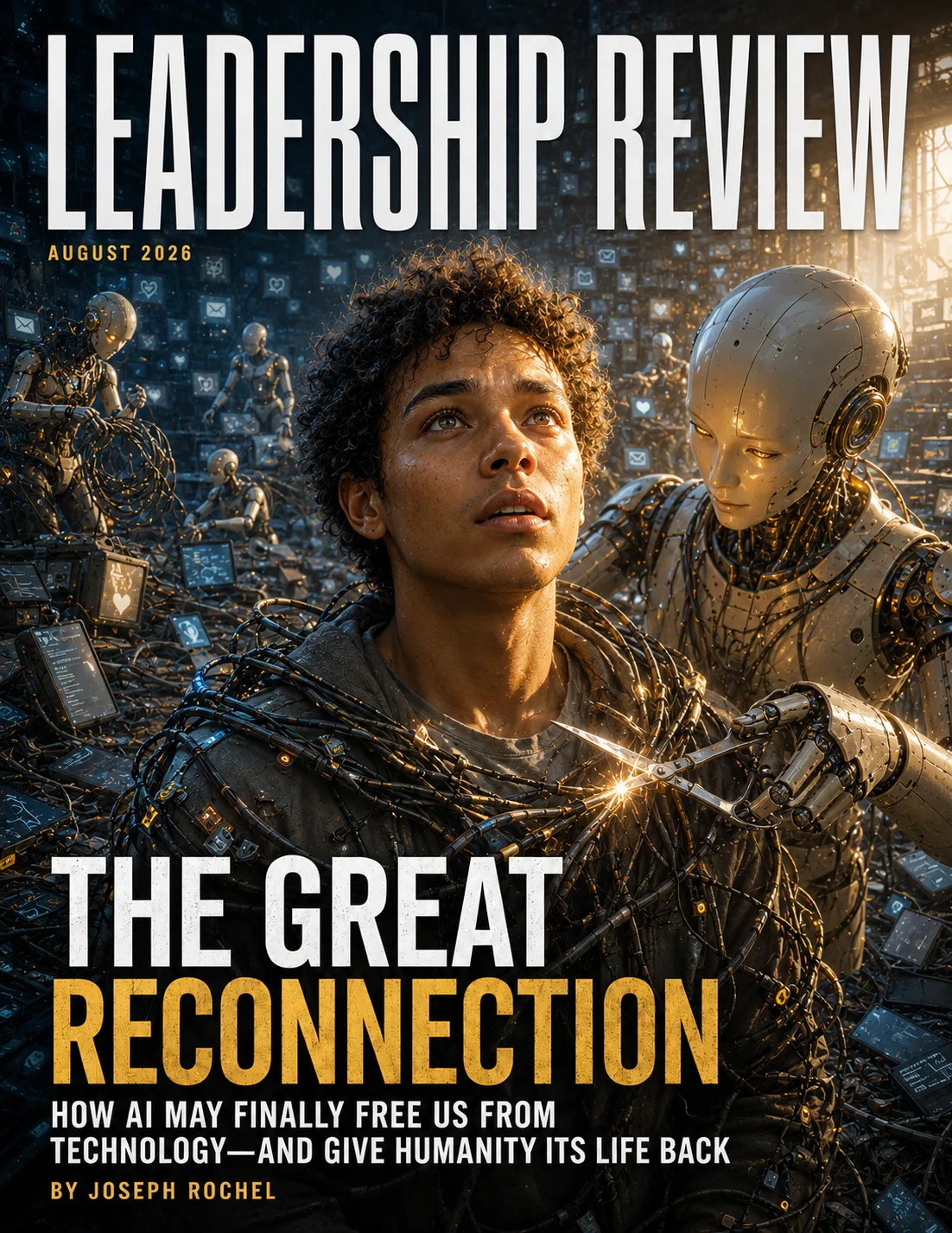
The Great Reconnection
How AI May Finally Free Us From Technology—and Give Humanity Its Life Back
We were promised flying cars, shorter workweeks, and machines that would handle the tedious parts of life. Instead, we got passwords, push notifications, and the expectation that every human being should be reachable every hour of every day.
Technology was supposed to give us more time. Somehow, it consumed nearly every waking moment.
We wake up to alarms on our phones, check messages before our feet touch the floor, spend the day moving between screens, and then collapse at night beneath the blue glow of one more scroll. Even rest has become something we track, measure, photograph, and occasionally interrupt to answer an email.
The chains do not look like chains. They look like convenience.
They arrive disguised as a helpful notification, an unread badge, a calendar reminder, a group text, a breaking-news alert, or a client who knows we saw the message because the little word read appeared beneath it. None of these things is evil by itself. Together, however, they have created a world in which our attention is always divided and our presence is perpetually on call.
For those of us who remember life before the internet followed us everywhere, there is at least a point of comparison. We remember leaving the house without a phone. We remember being unavailable without needing to apologize for it. We remember boredom, unplanned conversations, long drives without interruption, and the remarkable freedom of not knowing what everyone else was doing.
But for many people born after 2000, there is no life “before.” Constant connection is not something that happened to them; it is the atmosphere in which they learned to breathe.
They did not lose silence. They may never have been given it.
They did not surrender their free time. It was already being divided, monetized, and competed for before they were old enough to understand its value.
This is why the next chapter of artificial intelligence is so much bigger than faster emails, clever images, or machines that can answer questions. Properly used, AI may become the first technology in a generation capable of returning something technology has steadily taken from us:
our time, our attention, and ultimately one another.
The Tool That Cuts the Vines
There is an understandable fear that AI will become one more digital vine wrapping itself around our lives. We imagine another platform to learn, another dashboard to manage, another machine demanding our attention.
And if we use it poorly, that is exactly what it will become.
But the real promise of AI is not that it gives us more technology to operate. Its promise is that it can operate more of the technology we already have.
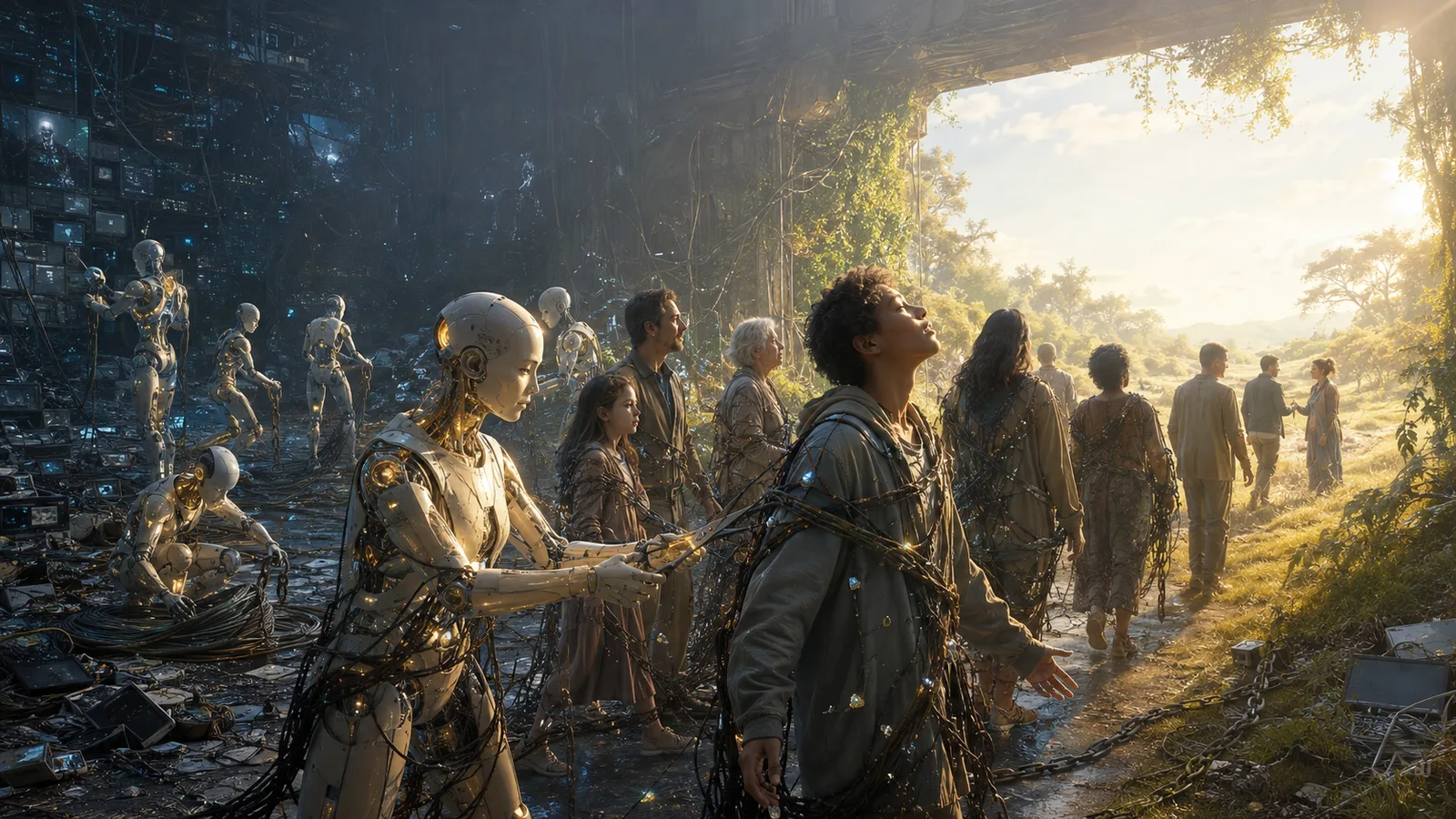
An AI agent can sort the information waiting for us. It can organize routine requests, prepare the first draft, remember the follow-up, find the document, summarize the meeting, coordinate the schedule, and handle the small repetitive tasks that quietly consume entire days. It can remain behind in the noisy digital room, untangling cords and closing windows, while we walk outside.
Perhaps the greatest promise of artificial intelligence is not that it can work like a human. It is that it can keep working while humans finally go live like humans again.
That distinction matters.
The goal should never be to remove humanity from our businesses, families, or communities. The goal is to remove the machinery that keeps humanity from showing up fully.
AI should not replace the conversation that requires compassion. It should help us arrive at that conversation less distracted.
It should not replace the leader. It should clear enough noise for the leader to lead.
It should not replace the parent, friend, teacher, caregiver, or neighbor. It should return some of the time those roles require.
The best AI will not make us feel as though we are spending more time with machines. Much of it will work quietly in the background, doing what good technology was always supposed to do: serving people without becoming the center of their lives.
Connected Was Never the Same as Connection
Over the past twenty years, we became the most connected civilization in history. We can reach nearly anyone, anywhere, at any time.
Yet reaching someone is not the same as knowing them.
We have hundreds of contacts but forget to call the people we love. We react to photographs from birthdays we did not attend. We know what strangers ate for lunch but may not know that the person sitting across from us is struggling.
The digital age solved distance while often deepening distraction.
AI gives us an opportunity to correct that—not by abandoning technology, but by restoring its proper order.
Imagine a business owner whose systems remember the details that matter: a client’s preferences, the promise made during the last meeting, the name of a spouse, the date of an important follow-up. The machine holds the information so the person can offer the attention.
Imagine a leader who can pause before sending the angry response and ask for help turning frustration into clarity. The machine does not create the leader’s character, but it can create enough distance for that character to lead.
Imagine a parent who no longer spends the evening buried in scheduling, forms, inboxes, and administrative chores because an AI agent has helped organize the noise. The time saved does not belong to the machine. It returns to the dinner table.
That is the Great Reconnection.
It is not humans forming a deeper relationship with artificial intelligence. It is humans using artificial intelligence to form deeper relationships with humans.
Freedom Will Require Leadership
Of course, none of this happens automatically.
Every tool carries the character and priorities of the person using it. AI can help reclaim our attention, or it can produce even more content designed to capture everyone else’s. It can reduce the pressure of constant availability, or it can raise expectations until every task must happen instantly. It can make work more humane, or simply help us squeeze more work into every remaining corner of life.
Efficiency alone has never guaranteed freedom.
If the time AI saves is immediately filled with more meetings, more messages, more output, and more digital noise, then we have not broken the chains. We have only made them more efficient.
Leaders must decide what the reclaimed time is for.
Is it for listening more carefully? Mentoring someone? Going home for dinner? Thinking before reacting? Sitting with a client long enough to understand the real problem? Giving employees room to create, rest, and return with something better than exhaustion?
Artificial intelligence can create the margin. Only human wisdom can decide what belongs there.
That may be the defining leadership challenge of this new era. The organizations that win will not necessarily be those that use AI to produce the most. They may be the ones that use it to preserve what their competitors accidentally automate away: trust, judgment, imagination, patience, and genuine human care.
Walking Back Into the Sunlight
The Great Reconnection is not a call to smash our phones, abandon the internet, and disappear into the wilderness. Technology has done extraordinary good, and AI will undoubtedly do more.
This is a call to remember the ancient order of things: tools are meant to serve people. People are not meant to serve tools.
For some, the coming years may feel like returning to a freedom they once knew—the freedom to be unreachable, to finish a thought, to sit in silence, to look another person in the eyes without glancing at a screen.
For others, it may feel like sunlight touching their face for the first time.
They may discover hours they never knew belonged to them. They may experience work that ends, conversations that are not interrupted, and moments that do not need to be recorded in order to matter.
Behind them will remain the tangled remains of the last twenty years: the alerts, feeds, tabs, passwords, cables, calendars, and endless requests for attention. AI agents may help us clean up that mess. They may cut away the digital vines one task at a time, carrying the burden of our systems without asking us to remain in the room and watch.
Ahead of us is something both new and very old.
Time to think.
Time to notice.
Time to sit with one another.
Time to be fully present in the life happening directly in front of us.
The future of AI should not be measured only by what machines learn to do.
It should be measured by what human beings are finally free to do again.