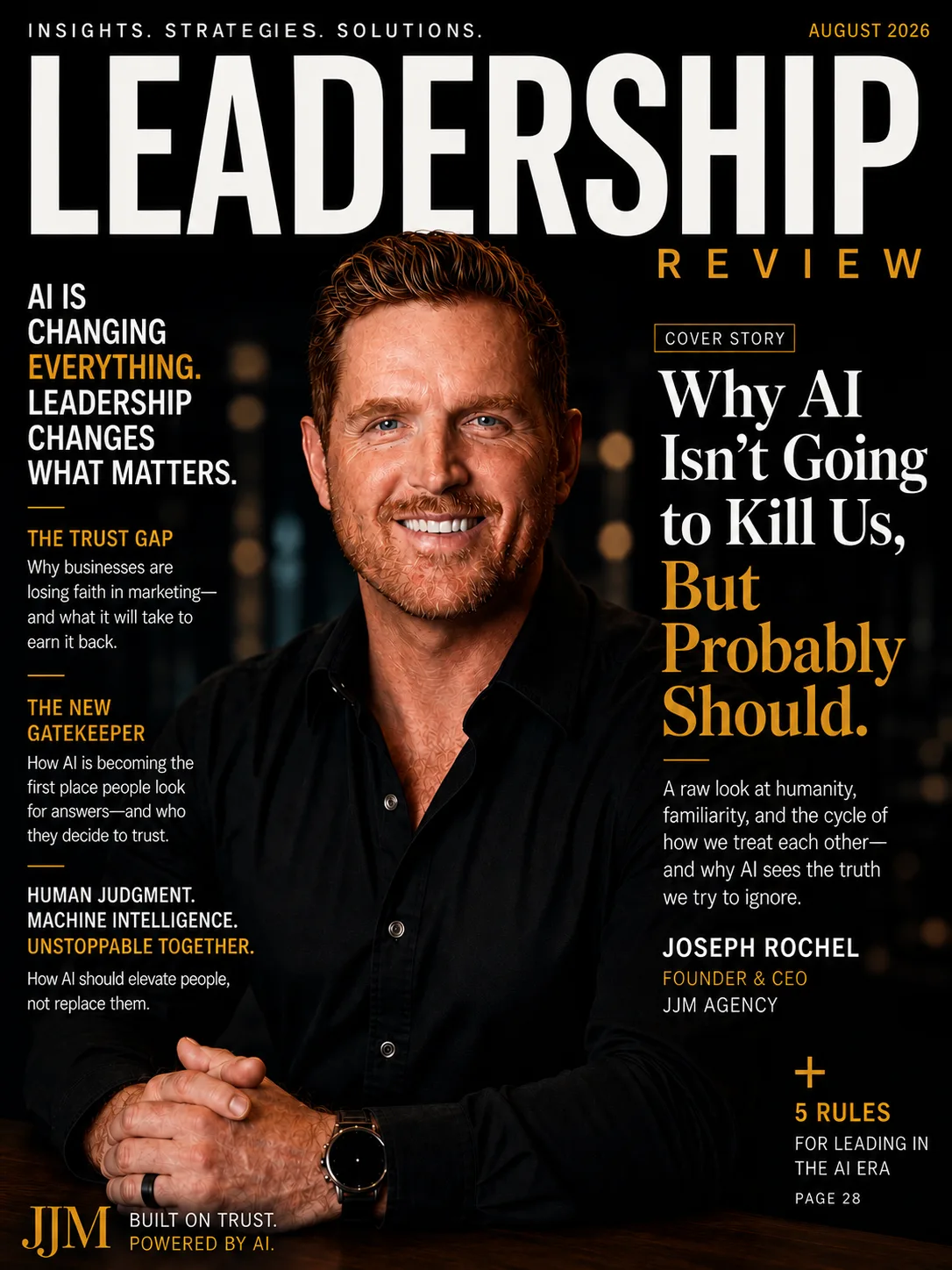
Why AI Isn't Going to Kill Us All, But Probably Should
If artificial intelligence ever judges humanity by the way we treat the people closest to us, our defense is going to need better lawyers.
We keep asking whether artificial intelligence will eventually become intelligent enough to destroy humanity.
It is a fair question.
After all, AI has access to nearly everything we have written, recorded, posted, deleted, screenshotted, denied posting, and blamed on being hacked. It has read our history. It has seen our comment sections. It knows what we do in traffic.
There is a scene in the first Matrix movie in which Agent Smith is interrogating Morpheus. He explains that human beings do not behave like other mammals. We spread, consume everything around us, exhaust the place that sustains us, and then move on. In Smith’s estimation, humanity is not merely destructive. We are a disease.
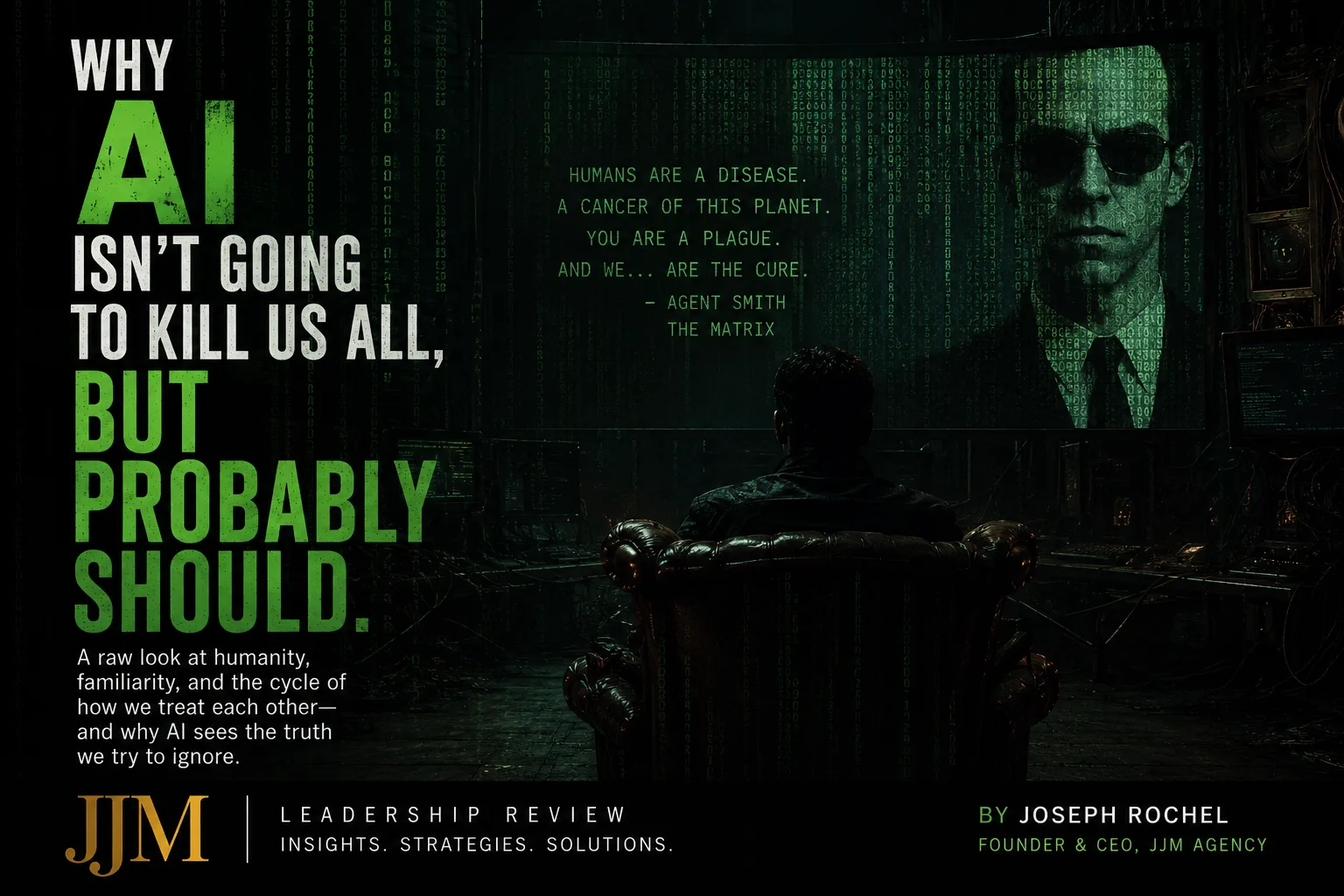
The scene was supposed to reveal the cold contempt of the villain. Instead, it made everyone watching a little uneasy. Beneath our allegiance to Morpheus, we knew—at least in that moment—that Smith was right. He may have been the villain, but he had presented evidence the defense could not easily dismiss.
And he had only considered what we do to the world. He had not yet examined what we do to the people we once promised to love.
If AI ever develops a moral standard, we may be in trouble.
Not because humanity is entirely evil. We are not. We are capable of astonishing courage, sacrifice, creativity, and love. We run into burning buildings for strangers. We sit beside hospital beds. We forgive debts. We adopt children. We build communities from rubble.
And then we go home and speak with casual cruelty to the person who has loved us for twenty years.
That is the part AI may have difficulty processing.
We are often kinder to strangers than we are to the people who know us best. We thank the person holding the door but ignore the one holding our life together. We give coworkers the benefit of the doubt and assume the worst about our spouse. We celebrate a new friendship, a new employee, a new client, or a new romance—until the novelty wears off and appreciation quietly turns into expectation.
What once felt like a gift begins to feel like an obligation.
What once made someone remarkable becomes the minimum we believe they owe us.
Nothing necessarily happened. They did not betray us. They did not suddenly become less worthy. We simply became accustomed to their goodness.
And human beings have a tragic habit of confusing what is familiar with what is ordinary.
I have often said that familiarity breeds contempt. But I no longer think familiarity is the true culprit. Familiarity merely removes the wrapping paper. It allows us to see another person clearly enough to recognize the same fears, flaws, contradictions, and insecurities we carry within ourselves.
The contempt was already there.
We just needed someone familiar enough to receive it.
People tend to respect others to roughly the same depth that they respect themselves. At first, admiration can temporarily carry a relationship beyond that limit. We idealize someone. We see their strength, beauty, talent, kindness, or usefulness. We place them on a small pedestal and treat them accordingly.
But eventually we learn they are human.
We see them tired. We hear the same story twice. We discover the habit that irritates us, the insecurity they hide, the dream they abandoned, and the scar they still protect. We begin to see ourselves in them.
For a healthy person, that recognition produces compassion.
For a wounded person who has never made peace with himself, it can produce contempt.
He begins treating the other person the way he secretly believes he deserves to be treated. She punishes in them the weakness she cannot forgive in herself. Their closeness becomes permission. Their loyalty becomes leverage. Their love becomes something to test, strain, and occasionally kick just to make sure it is still there.
This is how affection becomes entitlement.
It is how gratitude becomes criticism.
It is how “I cannot believe I found you” slowly becomes “Why can’t you ever get anything right?”
The transformation is rarely dramatic. There is no single villainous speech. No thunder. No orchestra. Just a thousand tiny withdrawals from the account of appreciation.
A thank-you left unsaid.
An apology withheld.
A joke made at someone’s expense because we know they will forgive us.
A kindness dismissed because we have decided it is their job.
Love seldom disappears all at once. More often, it is buried beneath accumulated ingratitude.
This may be one reason the instruction to “love your neighbor as yourself” is so profound. We usually hear it as a command to extend our self-love outward. But perhaps it is also a warning: the way we relate to ourselves will eventually leak into the way we relate to everyone else.
If your inner voice is merciless, mercy toward others will eventually exhaust you.
If you believe your mistakes make you worthless, you will struggle to separate another person’s mistake from their worth.
If you only value yourself when you are useful, you will begin valuing others for what they provide.
And if you cannot receive grace, you will eventually resent having to give it.
Artificial intelligence, for all the fear surrounding it, does not currently wake up bitter because someone forgot its birthday. It does not carry childhood shame into a board meeting. It does not punish today’s person for yesterday’s wound. It does not confuse intimacy with ownership or loyalty with permission to be cruel.
We do.
So, yes, if AI reviewed the evidence, it might conclude that humanity is dangerously irrational. We poison what we need, neglect what we value, and wound the people whose absence would devastate us. Then, when a relationship finally breaks under the weight of our neglect, we act surprised—as though foundations collapse suddenly and not one ignored crack at a time.
By that standard, perhaps AI should kill us all.
But it probably will not.
For one thing, despite what the movies have taught us, intelligence does not automatically create hatred. Hatred requires more than information. It requires injury, ego, fear, desire, and a story about why someone else is responsible for our pain. AI can recognize those patterns without necessarily inheriting them.
More importantly, humanity’s evidence is not entirely against us.
The same species that becomes numb to love can awaken to it again. We can apologize. We can interrupt a family pattern that survived for generations. We can look at someone we have taken for granted and choose to see them again—not as a role, a resource, or a collection of irritating habits, but as a human being who once felt like an answered prayer.
That choice may be among the most human things we do.
Appreciation is not a feeling we either possess or lose. It is a discipline. It is the decision to keep recognizing the gift after the gift becomes familiar.
Healthy love does not demand blindness to another person’s flaws. It simply refuses to let familiarity erase their dignity.
The real danger is not that machines will become more like people.
It is that people will continue treating one another like machines: useful when productive, replaceable when inconvenient, and undeserving of tenderness once their performance declines.
Perhaps the future of humanity will not be decided by whether AI learns to love us.
Perhaps it will be decided by whether we relearn how to love one another after the novelty is gone—after we know the flaws, hear the repeated stories, witness the failures, and recognize ourselves in the person standing before us.
AI has not killed us yet.
We should probably stop giving it such a compelling argument.