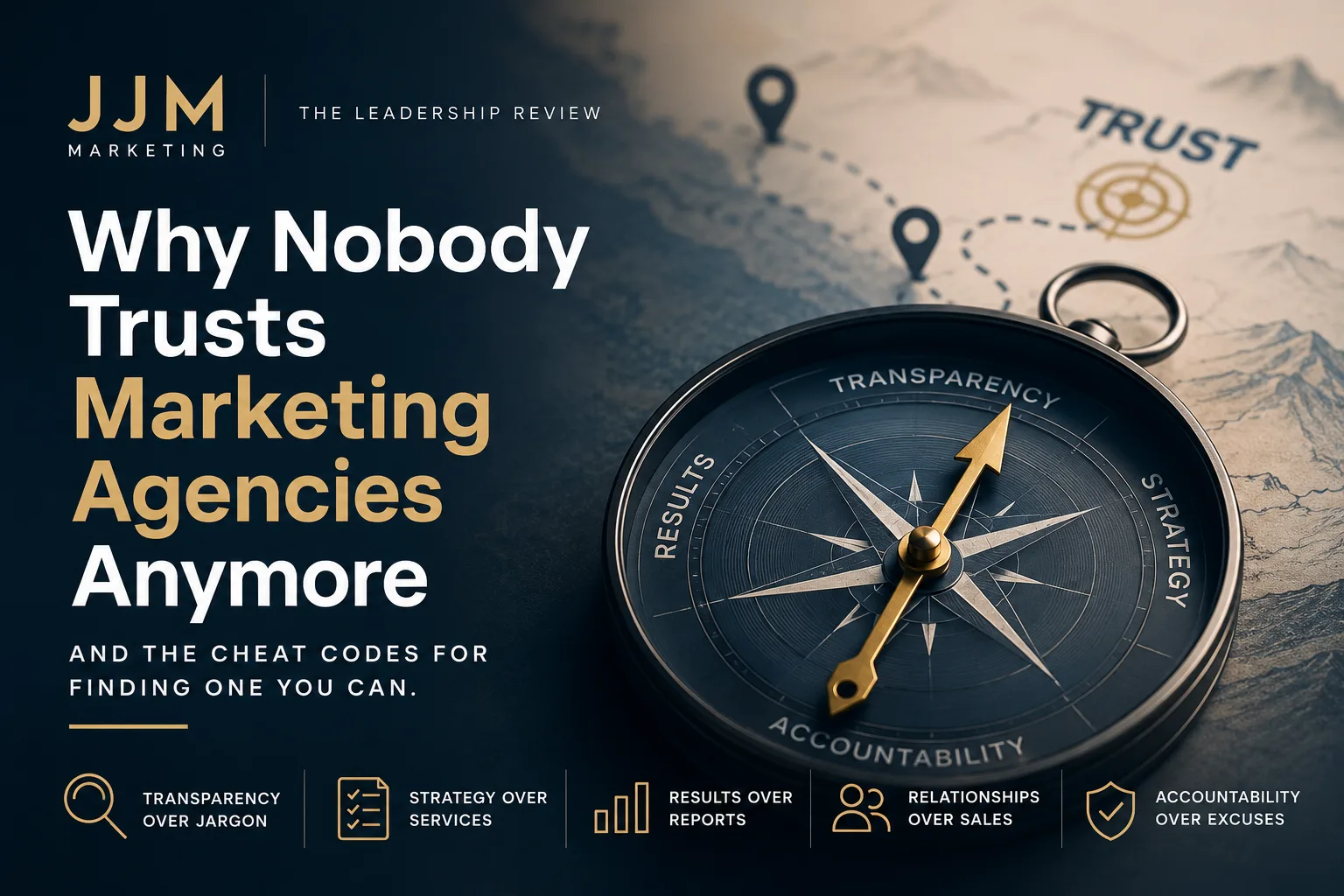
Why Nobody Trusts Marketing Agencies Anymore
And the cheat codes for finding one you can.
If you're a business owner who doesn't trust marketing companies anymore, I have some uncomfortable news for you:
We get it.
Actually, we don't blame you.
Over the past few years, marketing has become a strange mixture of legitimate professionals, charismatic salespeople, software resellers, self-proclaimed gurus, AI opportunists, and people who discovered GoHighLevel last Tuesday and opened an agency on Wednesday.
Everybody has the answer.
Everybody has the secret system.
Everybody can get you on the first page of Google.
Everybody has an AI that will supposedly run your entire company while you sleep.
And somehow, despite all those miracles…
Business owners keep getting burned.
So rather than trying to convince you that marketing agencies deserve your trust, let's start somewhere more useful.
The Top 10 Reasons Business Owners Don't Trust Marketing Companies Anymore
#10 — You have no idea what they're actually doing.
You get an invoice every month.
Maybe you get a report.
There are charts. Impressions. Clicks. Reach. CTR. CPC. Engagement.
It looks impressive.
But ask the simplest question—
"What did you actually do for me this month?"
—and suddenly the conversation gets complicated.
Cheat Code: Your marketing partner should be able to explain what they're doing in language you understand. Complexity isn't proof of expertise. Sometimes it's camouflage.
#9 — Everybody promises results they can't control.
"Guaranteed leads."
"Guaranteed rankings."
"Guaranteed growth."
Those phrases sound wonderful during a sales presentation.
But marketing doesn't happen in a laboratory.
Competition changes. Markets change. Customers change. Google changes. AI changes.
A legitimate marketer can guarantee their work, strategy, communication and accountability.
They cannot honestly guarantee human behavior.
Cheat Code: Be suspicious when someone guarantees an outcome that depends on variables outside their control.
#8 — You're paying for things you don't understand.
SEO.
Social media.
Listings.
Automation.
Funnels.
CRM.
Reputation management.
AI optimization.
The list keeps growing.
The problem isn't that these things don't matter.
They do.
The problem is that many businesses have been sold individual tools without anyone explaining how they work together.
Cheat Code: Don't ask what services you're buying. Ask what system is being built.
Good marketing should function like an engine. Every component should have a purpose.
#7 — The reports look great while the business feels exactly the same.
Congratulations!
Your impressions increased 38%.
Fantastic.
Did the phone ring?
Did somebody schedule an appointment?
Did anyone walk through the door?
Did revenue move?
Marketing metrics matter—but only when they're connected to business objectives.
Cheat Code: Ask your agency which numbers they consider success and why.
If every conversation ends with impressions and clicks, keep asking questions.
#6 — The salesperson disappears after the contract is signed.
This one is painfully common.
During the courtship, you're getting texts at 9 p.m.
After the contract?
You couldn't find that salesperson with a bloodhound and a search warrant.
Now you're communicating with an account manager you've never met who appears to be managing 87 other accounts.
Cheat Code: Before signing, ask: "Who will actually be responsible for my success after I become a client?" Then meet that person.
#5 — They're selling the same marketing plan to everybody.
Roofing company?
Same package.
Dentist?
Same package.
Restaurant?
Same package.
Financial advisor?
You guessed it.
Same package.
Different businesses have different customers, sales cycles, margins, competitors, reputational risks and buying behaviors.
Cheat Code: If someone recommends your marketing plan before deeply understanding your business, they're probably selling a product—not solving a problem.
Diagnosis should come before prescription.
Always.
#4 — They're reselling technology and calling it strategy.
This problem has exploded with AI.
There are incredible marketing technologies available today.
But owning software doesn't make someone a strategist any more than owning Photoshop makes someone a designer.
AI makes this even more important.
AI can accelerate good strategy.
It can also accelerate terrible strategy.
Cheat Code: Ask: "If I took away your software tomorrow, what expertise would I still be paying you for?"
The answer will tell you a lot.
#3 — Nobody takes responsibility when something doesn't work.
When marketing works, everybody wants credit.
When it doesn't?
It's the algorithm.
It's Google.
It's Meta.
It's your website.
It's your sales team.
It's the economy.
It's Mercury in retrograde.
Anything except the strategy.
Good marketing requires experimentation. Some things will work beautifully. Some won't.
That's normal.
Refusing to acknowledge failure isn't.
Cheat Code: Ask a prospective agency to tell you about a campaign that failed. Then listen carefully.
The best marketers won't hide from that question. They'll tell you what they learned and what they changed.
#2 — You've already been burned.
This may be the biggest obstacle legitimate marketing companies face.
We're rarely starting with a clean slate.
We're walking into a room filled with ghosts.
The SEO company that disappeared.
The website developer who never finished.
The social media agency that posted generic graphics for six months.
The lead company that delivered garbage.
The "AI expert" who installed software nobody knew how to use.
Trust doesn't reset because there's a new logo on the proposal.
Cheat Code: Don't give a new agency blind trust. Give them the opportunity to earn it.
Start by evaluating how they communicate, diagnose problems, explain strategy and handle difficult questions.
Trust should be built in inches before it's measured in miles.
And the #1 Reason Nobody Trusts Marketing Companies Anymore…
Because marketing companies keep asking for trust before they've earned it.
That's really the heart of the problem.
Marketing is an industry built around persuasion.
And somewhere along the way, we became too good at persuading people to buy marketing—and not good enough at making sure they understood what they were buying.
So perhaps the industry needs a reset.
Less pitching.
More diagnosing.
Less jargon.
More transparency.
Less "trust me."
More "here's how you can verify what I'm telling you."
Because the future of marketing isn't going to belong to the company with the slickest presentation.
AI is making slick presentations cheap.
It won't belong to whoever shouts the loudest.
AI can make everyone loud.
And it certainly won't belong to the agency with the biggest collection of shiny tools.
Technology eventually becomes available to everyone.
The advantage that remains scarce is much older:
Trust.
The Ultimate Cheat Code
Before hiring your next marketing company, don't ask:
"Can these people market my business?"
Ask something harder:
"Would I invite these people into my business?"
Would you let them see what's working?
What's failing?
Where you're vulnerable?
What you're afraid of?
Would you trust them enough to tell you when your idea is wrong—even if telling you costs them money?
Because that's the relationship you're actually buying.
Not ads.
Not SEO.
Not social posts.
Not AI.
You're choosing people who will help influence how the world sees the business you've spent years building.
Choose accordingly.
The best marketing relationship shouldn't feel like hiring another vendor.
It should feel like gaining someone on your side of the table.
And if you're a marketing company reading this?
Stop asking businesses to trust you.
Become the kind of company they can.
The Leadership Review
Leadership, business, technology and the human principles that shouldn't change just because the tools do.